

Exclusion
Tab navigation
Overview
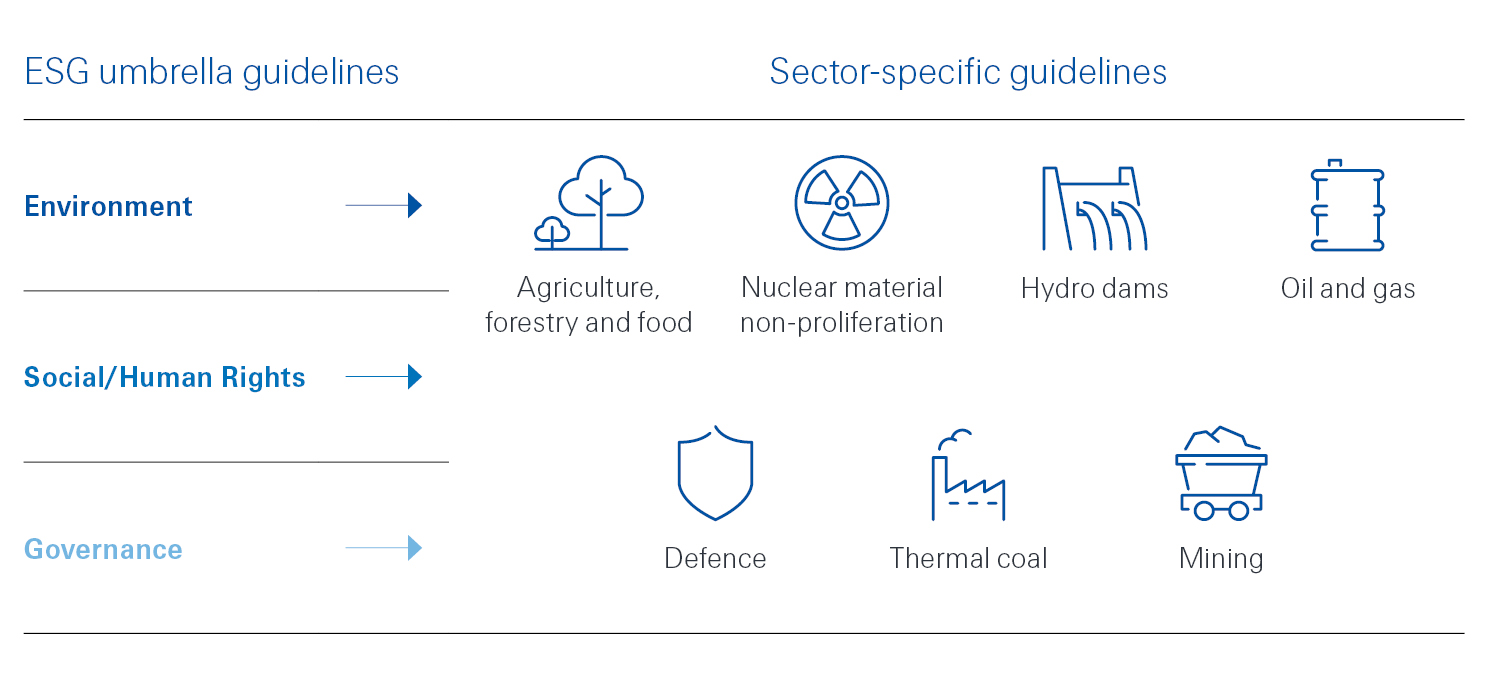
Swiss Re’s approach to exclusion is based on the Group-wide ESG Risk Framework, which sets criteria for what Swiss Re considers acceptable business and may lead to restrictions of companies or countries from its investment universe. The Framework is based on the overarching principles of protecting the environment, respecting human and labour rights, as well as promoting good corporate governance.
ESG Umbrella guidelines infographics visual element
Additionally, Swiss Re considers the way companies conduct their business by screening their alignment with the UN Global Compact Principles on human rights, labour, environment and anti-corruption, where information granularity is available. Companies that fail to meet the UN Global Compact Principles based on a third-party assessment 1 are restricted from the investment universe. Accordingly, internal and external investment managers are not allowed to invest in such assets on behalf of Swiss Re.
Swiss Re's mid-term objective for 2030 is to fully exit coal mining and coal-fired power generation companies for its corporate bond and listed equity portfolios via normal portfolio reallocations. Swiss Re has already taken action in recent years by introducing thresholds for coal as well as oil and gas related investments as described in the KPI section.
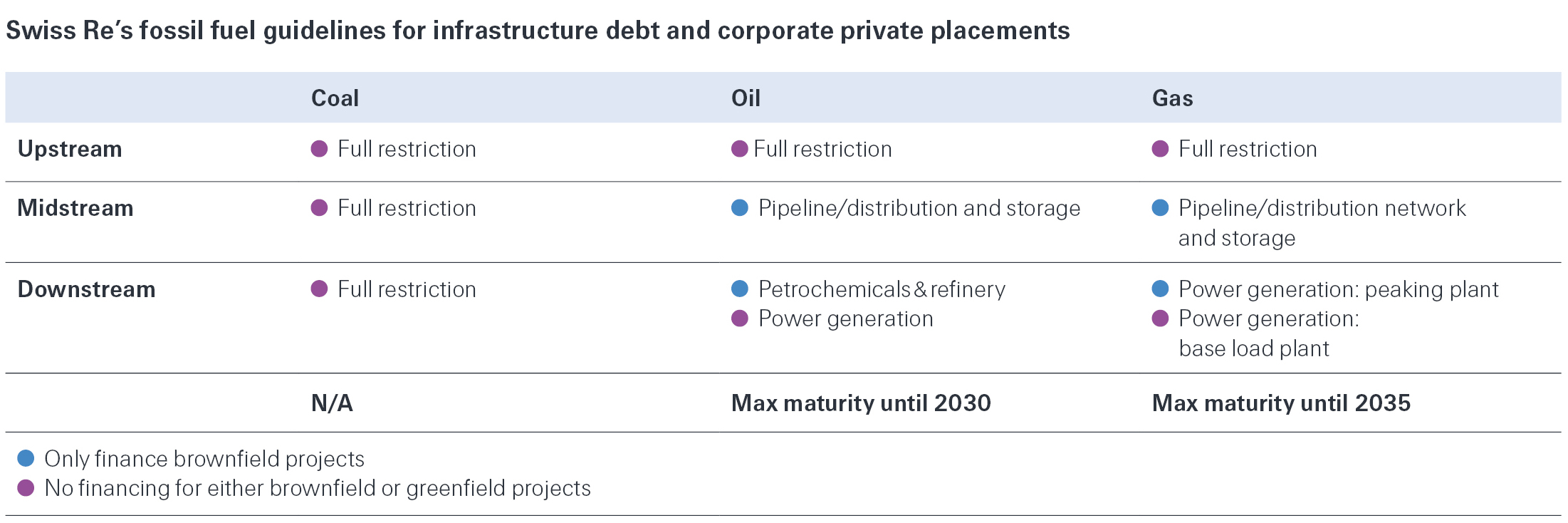
Furthermore, for its infrastructure debt and private placement portfolio, Swiss Re applies dedicated fossil fuel guidelines.
Footnotes
Footnotes
1 Based on MSCI ESG Research LLC, “MSCI ESG Controversies and Global Norms Methodology”, msci.com, 12 October 2023. Companies with a “fail” or a “watch list” regarding UN Global Compact compliance in combination with an overall controversies flag “red” that indicates whether a company has a notable controversy related to its operations and/or products.