

Enhancement
Tab navigation
Overview
Enhancement refers to the systematic integration of ESG criteria along the entire investment process, from Strategic Asset Allocation (SAA) to monitoring and reporting. Today, ESG aspects are considered for close to 100% of Swiss Re's SAA 1. Based on the risk-adjusted return profiles tracked by Swiss Re, including ESG criteria into investment portfolios can make economic sense, especially over the long term.
Swiss Re strives to invest in issuers that are addressing sustainability-related challenges and opportunities by taking into account their exposure and ability to manage such risks. For its sovereign, supranational and agency bonds, Swiss Re has been applying a minimum ESG rating threshold, whenever available. Any possible exception from the minimum rating would be driven by Asset-liability management (ALM) considerations.
In 2017, ESG benchmarks 2 were implemented for the actively managed listed equity and corporate bond mandates 3. Limited leeway for deviations is given, whereby such investments are required to have either a positive ESG trend or provide compensation for the underlying ESG risk. The implementation of these benchmarks allows Swiss Re to have both the right measurement and appropriate incentives for our investment managers in place. If benchmarks are not applicable, a minimum ESG rating threshold2 is applied to the mandates, such as the buy-and-maintain corporate bond mandates.
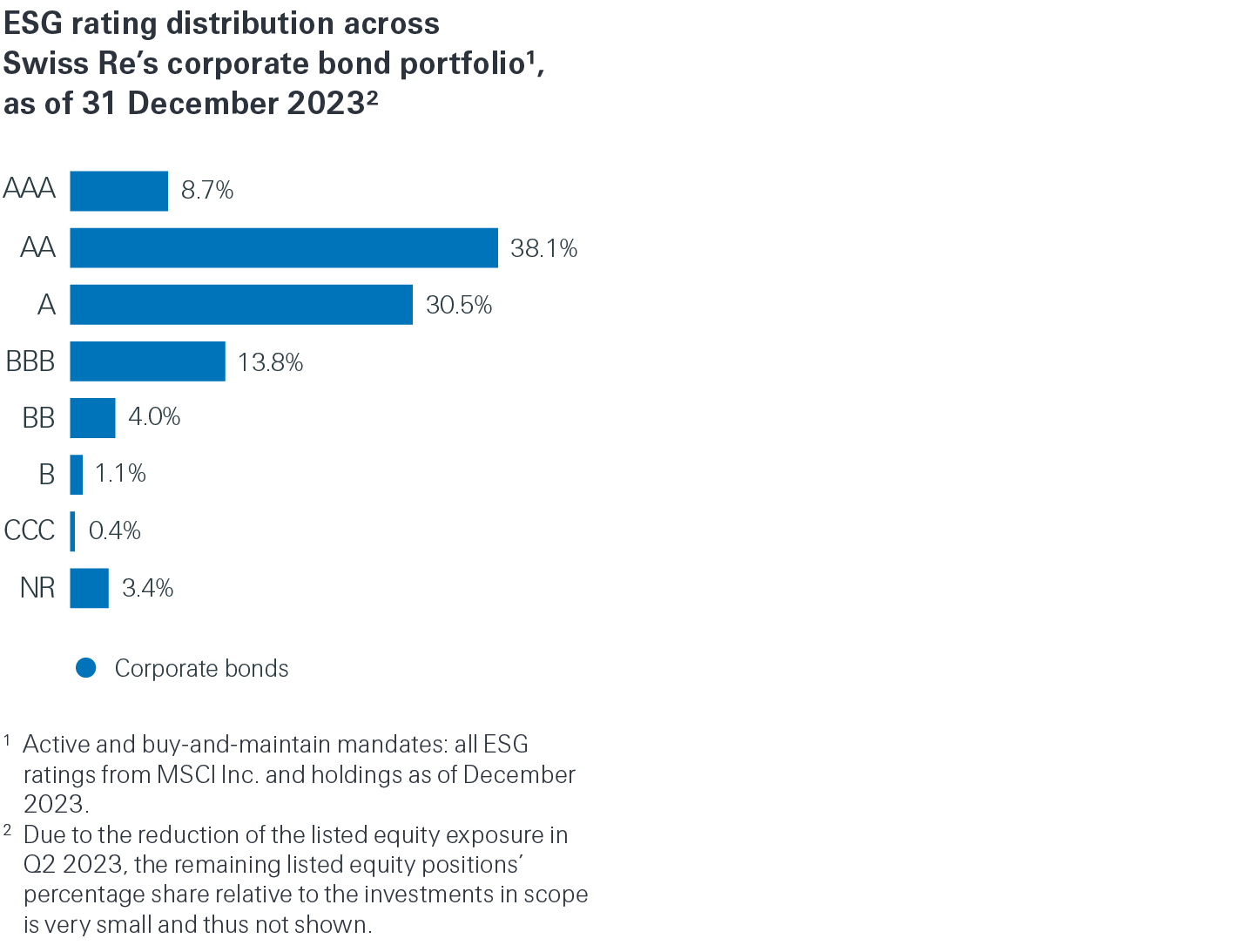
The ESG ratings applied to companies reflect the investees’ exposure to and management of sector-specific key ESG risks, including the ones Swiss Re has identified as financially material. Swiss Re defines and contractually agrees these ESG rating requirements with its investment managers. Swiss Re considers the application of minimum ESG ratings an effective measure to limit exposure to companies with weaker sustainability and related financial performance. This is reflected in the ESG rating profile of Swiss Re’s corporate bond portfolio 4, as shown in the KPI tab.
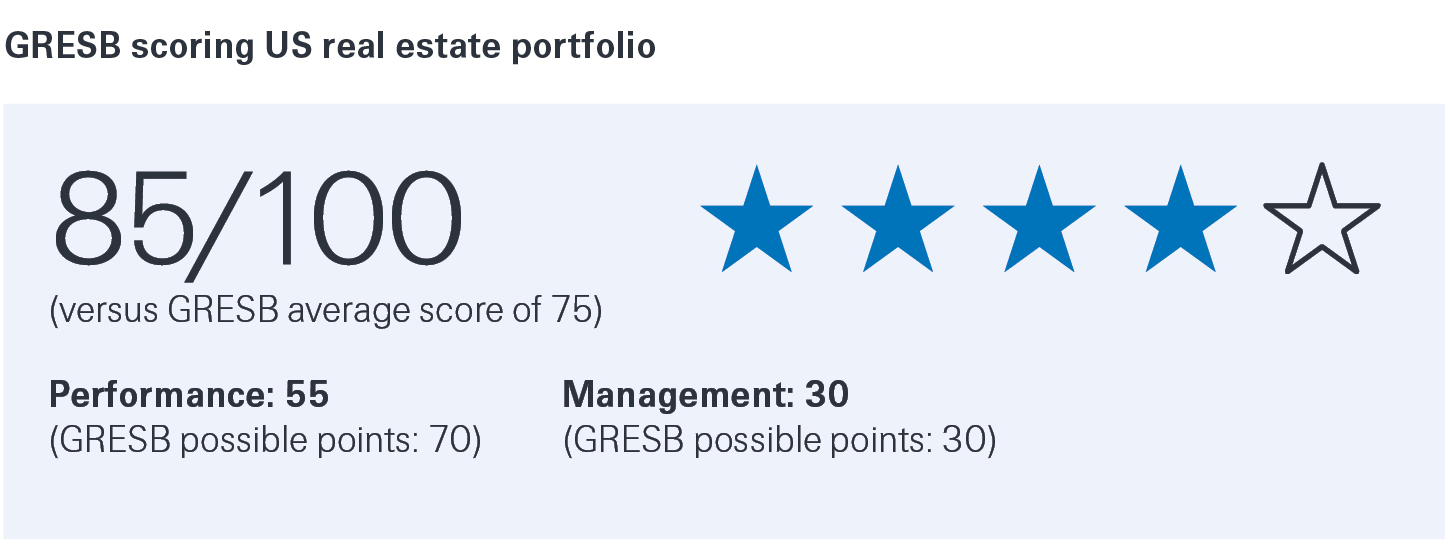
For its real estate portfolio, Swiss Re evaluates new investments in properties from an environmental and social perspective, and strives to improve the sustainability characteristics of properties already in the portfolio, as economically sensible. Connected to that, Swiss Re's US real estate investments are benchmarked against GRESB, an industry-driven organisation sharpening the way capital markets assess the ESG performance of real assets.
For Swiss Re’s Principal Investments, the majority of investee companies 5 is monitored with regard to their ESG related performance with a focus on environmental and governance aspects.
References
Footnotes
1 The SAA consists of the overall investment portfolio less securities lending, repo assets, collateral balances and income on cash.
2 Based on MSCI ESG Research LLC, “ESG Ratings Methodology”, msci.com, October 2023.
3 A mandate is defined as the contractual agreement for the management of a subset of assets according to a specific strategy.
4 A portfolio is defined as the aggregated collection of the asset type specified.
5 Based on investment amount in USD as of 31 December 2023.