


The 100-year legacy of Japan's Great Kanto Earthquake
Article information and share options
This article was written
By
The Great Kanto Earthquake in Japan in September 100 years ago claimed around 105 000 lives, the largest loss of life from any earthquake in Japan in recorded history.
Key takeaways of this publication are:
- The Great Kanto Earthquake is still Japan's worst natural disaster, with more than 100 000 lives lost and economic losses of close to a third of its GDP in 1923.
- Despite extraordinary improvement in the structural resilience of buildings, seismic risk is still extremely high in Japan.
- Today, the high concentration of population and wealth in the Tokyo region mean a serious quake could cause insured losses of an estimated USD 130-150bn.
- This would be the highest ever loss globally from one event.
Scroll
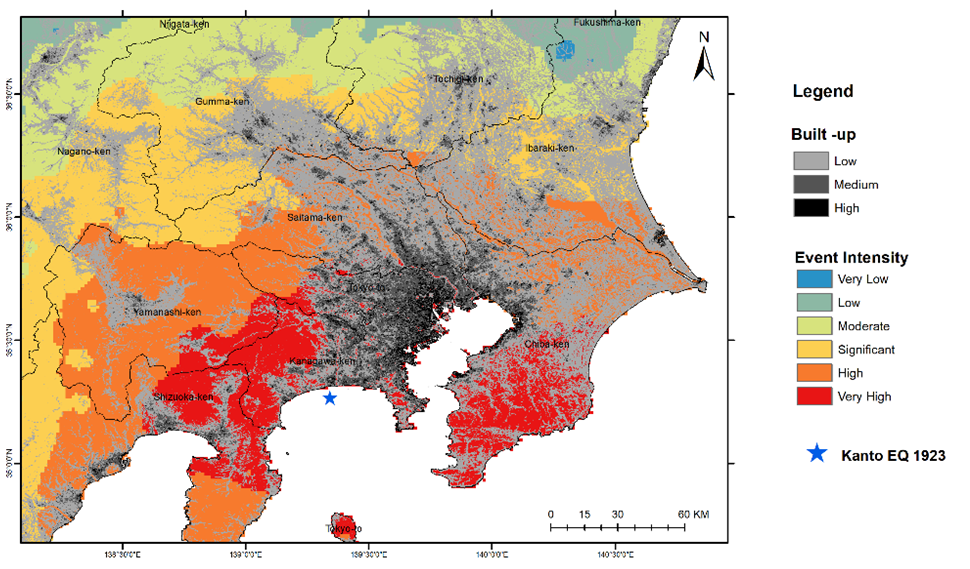
Figure 1 - Increased risk exposure in extreme seismic hazard zone in and around Tokyo (Kanto region). Built-up volumes 2025 and 1923 earthquake footprint.
The disaster sparked the development of a strong culture of risk prevention and preparedness in Japan: necessarily so, given the high probability of further strong earthquakes there. However, despite the strict building codes and other measures, earthquakes in Japan could still trigger staggering losses. For example, the economic losses from a Mw 7.3 quake beneath the Tokyo Metropolitan area could be nearly USD 1 trillion in today's prices – and we estimate that the associated insured losses could be almost twice the annual average loss from all natural disasters globally for the last 10 years.3
Japan is one of the world's most earthquake-prone countries. Since 1950, it has been struck by four large quakes of Mw 8 or more, and 148 mid-sized earthquakes of Mw 5-7.4 The Tokyo Disaster Management Council estimates up to a 6% probability of a repeat Mw 7.9 earthquake striking the city within the next 30 years.5 Today, strict building codes are continuously updated to increase the seismic resistance of buildings.6
It is a testament to these high standards that in 2011, the Mw 9 Tohoku earthquake and tsunami saw relatively low loss of life despite being the strongest-force quake ever to strike Japan, and the fourth-strongest worldwide.7 Even so, and despite it striking a relatively rural region, economic losses were above USD 280 billion (inflation adjusted), the highest from any natural catastrophe globally since 1970. The event also exposed vulnerabilities, since most deaths and about a third of the economic damage were caused by the follow-on tsunami, which breached preventative seawalls, rather than the quake itself.
Today the height of seawalls has been increased to make mitigation readiness higher than in 2011. But Japan still has a sizeable percentage of buildings constructed before 1981, when the last major update to the building code took place.8 If a major earthquake were to strike the Kanto region again today, the human toll and economic fallout could be vast. The region is very densely populated and has a high concentration of asset value (see Figure 1). It is home to about 39 million people, more than four times that of 1920, and produces 39.3% of Japan's GDP as of 2019.9
In 2022 the Tokyo Metropolitan Government estimated that a Mw 7.3 quake below the city – an event with an expected 70% probability in the next 30 years – could claim 6 000 lives and destroy or severely damage more than 190 000 properties. The estimated economic loss from direct and indirect damages would be JPY 95.3 trillion, or USD 940 billion in today's values – about 3.5x the typical total economic loss from all natural disasters globally in a year. We estimate the associated insured losses from residential and non-residential claims at about JPY 13.3-15.2 trillion, or USD 130-150 billion today: the biggest ever single-event loss to the global insurance industry. In Japan, the underwriting risk on earthquake is shared between government and private sectors. Despite Japanese non-life insurance companies' capital resilience under stringent solvency regulation, earthquake risk in Tokyo remains a major threat that calls for continuous strengthening of worst-case scenario planning and modelling of all loss drivers.
references
References
1 Earthquake Insurance in Japan, General Insurance Rating Organization of Japan, October 2022.
2 https://www.boj.or.jp/en/about/press/koen_2011/data/ko110628a.pdf
3 sigma 1/2023: Natural catastrophes and inflation in 2022: a perfect storm, Swiss Re Institute.
4 Recent earthquakes and their magnitudes in Japan, worlddata.info.
5 Report on Estimated Damages in Tokyo Due to an Earthquake Directly Beneath the Capital, Tokyo Disaster Management Council, 2013.
6 See Building Standards Act, English, Japanese Law Translation.
7 20 Largest Earthquakes in the World Since 1900, USGS, 26 June 2019.
8 https://www.eeri.org/site/images/awards/reports/reithermanpart1.pdf, EERI, 2008.
9 Japan Prefectures Population from 1920 and Area (demographia.com); Japan Cabinet Office.